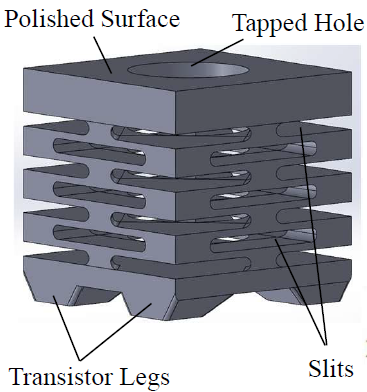
Press-pack power modules clamp semiconductor dies between electrodes with springs. The stacked stainless-steel disc springs used in IGBT modules add resistance, inductance, and thermal resistance that SiC devices switching ten times faster cannot tolerate, and SiC dies are too small to press-contact at all. I designed a single beryllium-copper block with interleaved laser-cut slits that acts as the spring, the conductor, and the heat path at once, with four sintered legs bonded directly to the dies.
The design was optimized by scanning the slit geometry in COMSOL through LiveLink for MATLAB against a 1000 MPa body-stress limit at 650 N clamping force. The chosen point gives 0.773 mm deflection, 874.7 MPa peak stress, 148 µΩ DC resistance against 856 µΩ for the disc-spring assembly it replaces, and 2.8 nH stray inductance. Fabricated parts tested on an Instron frame stayed in the elastic region and recovered their shape, and measured resistance and inductance agreed with simulation. This work is the basis of two U.S. patent applications on which I am a co-inventor.
Mathematical background
- Finite element analysis of coupled structural and electrical fields
- Discrete design-space optimization under stress and deflection constraints
- Skin effect and stray inductance at switching frequencies of 20 kHz